
BESPOKE LEADWORK FOR PITCHED & FLAT ROOFS IN FOREST ROW
Not every roof is built in the same way. Some have steep slopes, while others have flat or gently sloping sections. Many properties will have a combination of both. This can mean the leadwork needed on one roof might be quite different from the work required on another. By bringing in a team of leadwork specialists, you will be dealing with people who understand the differences.
Lead is a useful roofing material. It can be formed to suit different shapes and junctions. This makes it suitable for work on both pitched roofs and flat roofs.
However, it must also be installed correctly to provide reliable weather protection.
At Traditional Leadwork, we help property owners in Forest Row with bespoke leadwork that is specifically designed around the individual requirements of their roofs.
WHY BESPOKE LEADWORK MAY BE NEEDED
Standard components are suitable for many jobs but some areas need an individual approach.
A roof might have an unusual shape, an awkward junction or an existing detail that needs to be properly matched. Lead can be cut and formed to fit these areas. It can also be used to create weatherproof coverings and details that would be difficult to achieve with some other roofing materials.
The important thing is to consider more than the shape of the finished work on lead roofs.
Lead expands and contracts as temperatures change. Joints, fixings and the size of individual sections must allow for this movement. Good drainage is also essential.
Bespoke leadwork needs to suit the design of the roof and the appearance of the building.
BESPOKE LEADWORK FOR PITCHED ROOFS
Pitched roofs in Forest Row are designed to shed rainwater down their slopes. They are usually covered with slates or tiles, but lead is often needed where different parts of the roof meet.
Chimneys are one example.
Lead flashings can be formed around the base of a chimney to help prevent water entering the junction between the chimney and roof covering. Dormer windows are another common area for leadwork. Depending on their design, they may need lead flashings, coverings to their sides or a lead-covered roof.
Roof valleys can also require specialist attention. These are the channels formed wherever two roof slopes meet, and some valleys are lined with lead to carry rainwater away.
Other examples include leadwork around roof windows, changes in the roof level and awkward junctions against walls. Each detail must suit the pitch of the roof, the surrounding materials and the amount of water it may need to manage.
BESPOKE LEADWORK FOR FLAT ROOFS
Flat roofs have different requirements.
Although they are described as flat, they should normally have suitable falls that help rainwater to drain away. Some flat roofs use lead as their main covering. Others use different systems or waterproofing materials but may still need leadwork at certain junctions.
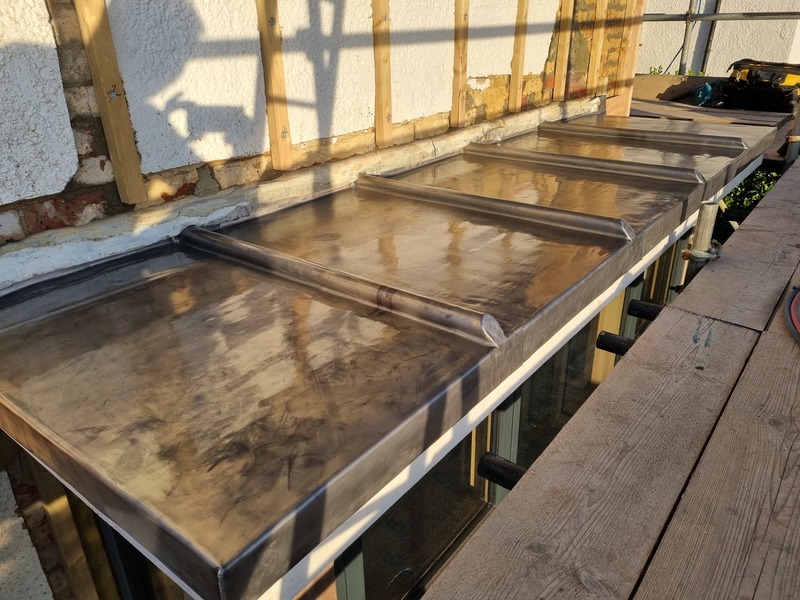
Where lead forms the roof covering, the size of the sections, the arrangement of the joints and the way the material is fixed all need careful consideration. A flat or low-pitched lead roof may also need bespoke details around rooflights, outlets, parapet walls and changes in level.
Lead can be formed into upstands where the covering meets a wall or another vertical surface.
Drainage outlets and gutters may also require carefully designed lead components for directing water away from the roof. These details are particularly important because water can collect if the drainage arrangements are unsuitable.
Roofing companies and leadwork specialists often have different levels of experience, so it is worth choosing tradespeople who understand how to form and install intricate lead detailing.
WHAT ABOUT LEAD ROOF FLASHING?
Lead roof flashing is used on both pitched and flat roofs, but the details can be quite different.
On a pitched roof, flashing often protects the junction between slates or tiles and another part of the building. On flat roofs, it may form part of the waterproofing detailing where the roof covering meets a wall, a parapet or a raised feature. The amount of overlap, the height of the upstand or the method of fixing, or all three, will depend on the particular application.
A detail that works on one roof in Forest Row will not necessarily be suitable for another.
This is why a roofer must understand the roof construction before choosing how lead flashings should be formed and installed.
WHEN EXISTING LEADWORK NEEDS ATTENTION
Bespoke leadwork is not only needed on new roofing projects.
Older roofs may have damaged flashings, split lead coverings or joints that no longer provide a suitable level of weather protection. Sometimes the existing detailing can be repaired. In other cases, a new section may need to be formed to suit the surrounding roof. Before carrying out lead roofing repairs, it is important to find out why the original leadwork failed.
A split caused by restricted thermal movement, for example, might return if the replacement is installed in the same way. The condition of supporting materials and drainage arrangements should also be considered.
The aim is to address the cause of the problem rather than simply cover up the visible damage.

CHOOSING THE RIGHT EXPERIENCE
Many roofing companies work on pitched roofs and flat roofs. Others might have considerable experience with lead. However, more complicated details may benefit from the involvement of leadwork specialists. This is especially true where new lead components need to be formed to fit unusual shapes or existing architectural features on a property in Forest Row.
When choosing a roofer, it is worth asking about similar projects they have completed.
The contractor should be able to explain what leadwork is needed, how it will be installed, and why the proposed approach is suitable for your roof.
BESPOKE LEADWORK IN FOREST ROW
Whether your property has a pitched roof, a flat roof or a combination of the two, the leadwork should be designed to suit the structure. A careful assessment can help establish which details are needed, whether existing leadwork can be repaired, and where any new components may be required.
Traditional Leadwork can discuss your requirements and help you to understand every option available for your property in Forest Row.
If you would like to arrange a discussion about a project, please contact us to find out more.